Monthly Archives: February 2013

Eating Disorders in Recovery & our response to them

Share

National Eating Disorder Awareness Week (Feb. 24-March 2, 2013)

In 1990, I saw the profoundly disturbing movie Eating by Henry Jaglom. Prior to this, I was oblivious to eating disorders. The film was about a group of women cooking for a celebration. Throughout the film, they individually act out in their respective eating disorders. Watching their secrecy, shame, self-loathing, and powerlessness triggered an overwhelming sense memory in me. What they were feeling was no different than how I felt shooting coke in a locked bathroom. It made me realize how similar eating disorders were to addiction. Seeing this film helped me to feel empathy and compassion for my women friends who continued to struggle with bulimia even after years in recovery.

Our society isn’t very compassionate toward people who have diseases that manifest in self-destruction.  “How can I feel sorry for him? No one is putting a gun to his head forcing him to take heroin.”  While society is finally becoming educated in substance abuse and depression, eating disorders make people uncomfortable. It is cruel when adjectives such as lazy, greedy, and glutinous are used to describe over-eaters and those suffering from obesity. It is just as cruel to pretend there isn’t a disease affecting the health of a friend. People in 12-Step meetings become uncomfortable, even angry, if a member shares about vomiting after meals even if they share that this behavior makes them want to get high. The  whispering and dissing of the “skinny girl” is harmful and hateful. Eating disorders do not arise out of thin air. Childhood pain, violence, trauma, abuse, and sexual abuse are often at the core.

Recovering addicts and alcoholics with eating disorders are fortunate to already have a language to describe their experience. They have recovery tools and support. They know how to walk into a fellowship for their specific eating disorder and ask for help.  Yet, even with this leg-up, the road to ED recovery is riddled with potholes. I know many women with decades clean and sober whose recovery from bulimia continues to be two steps forward one step back. Binge eating relapses keep them trapped in a cycle of shame, self-berating, hopelessness, and despair even while they are role models of recovery in their primary 12-Step group.

Sustainable recovery from eating disorders is very difficult and painful and we (society as a whole and those of us fortunate to be in recovery ourselves) should be extending kindness, support, and compassion to anyone who is suffering so that they do not have to isolate in secrecy and shame. We can help by encouraging them to be honest and courageous, and by guiding them to professionals who can give them the help they need. Our generosity and love does not have to be insular. We have enough that it can be shared beyond the confines of our particular substance abuse group.

A dear friend in recovery became anorexic this past year. At first, I tried helping by applying what works to cut through the denial and arrest the disease of addiction but this was different. I realized she needed professional help and we found a therapist willing to work within her budget. After several months, it was clear that she needed a higher level of care – inpatient. Unfortunately, unlike drug addiction, there is very little help available in America for anorexics without financial resources. Anorexia Nervosa is a disease that leads to death – if not from starvation, it can cause a heart attack, fainting behind the wheel, shattered bones, and major organs shutting down. Many anorexics commit suicide before their bodies fail. Yet even with the high suicide rate statistics, there is very little help offered to people without $30,000 to spare or comprehensive health insurance. In my friend’s case though, it’s going to take more than good insurance or extra cash in the bank. Even after being discharged from therapy and told she needs a higher level of care, the denial continues to convince my friend that this disease can be self-managed.

No one could force me to get clean and I can’t force her into inpatient treatment. I hope she becomes willing. I continue to encourage her to not give up, to pray to whatever she believes in or doesn’t believe in, to blindly ask the universe or her own heart to guide her to safety so she can live. She asked me to dedicate this week’s blog in honor of Eating Disorder Awareness Week.

You may have friends in recovery living in shame, guilt and secrecy, suffering from an eating disorder they have not made public. These friends are your opportunity to practice empathy, compassion, tolerance and patience. Help them to feel safe enough to bring their ED out of the darkness. Eating disorders are not gender specific. Men this is your opportunity to bring your ED out of the closet so other men will not feel so alone. Together, in loving kindness, we can all recover.

For anyone reading this blog who may be suffering from an eating disorder, there is plenty of information online for local helplines, resources, 12 step groups. Not everyone needs to go to a treatment facility. Most eating disorders can be arrested and a healthy recovery can occur using a combination of 12 step meetings, therapy, trauma work (such as EMDR or gestalt therapy), and Dialectic Behavioral Therapy (DBT) groups, mindfulness (such as meditation, yoga, breathing exercises). Your life is worth it.

The following is a guest blog written by my friend who has Anorexia Nervosa. I asked her to write about her inner experience living with this disease. Perhaps next year she will be able to share her recovery from this illness.

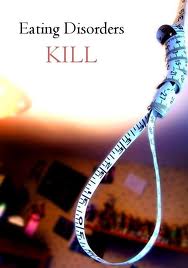
eating disorders kill


Anorexia? WTF Happened?

During the course of this vicious anorexia cycle, I have confided consistently with one person. This alone may have saved my life— so far.

I don’t exactly remember when the idea had surfaced that I had an eating disorder.  At some point in late 2011 something started happening internally that resulted in an increase of anxiety, not sleeping, not eating, horrible leg cramps, night terrors, depression, anger, and hopelessness.  By April 2012 I had been in therapy for five months and remember feeling completely disconnected from my body. My mind was constantly spinning and I had 3 years clean from drugs and alcohol. I wanted to escape the screaming in my head and the pressure I constantly felt. Using and suicide bounced in and out of my mind.

I had slowly stopped eating. Well- I wouldn’t eat a couple days, but then would eat a few days and be fine. I didn’t really obsess over it and it was just one of those habits I think I had always had- since childhood. The idea of eating never really mattered to me much and the thoughts of over eating (or watching others over eat) grossly disgusted me. My frame is naturally small and the most weight I had ever gained was through both my pregnancies which I absolutely hated. Even though I had lost all the weight I had gained through my practically back to back pregnancies, my body was left with deep stretch marks which leave me with a strange self-conscience feeling I still have to this day.

Eventually, my first therapist kicked me out after about 10 minutes of what ended up being our last session. She looked at my sick body and advised me to come back after I sought help for my eating disorder. I hadn’t really talked much to this therapist but felt extreme anxiety when I knew I had an appointment that day and felt like I had been hit by a bus when I left. I don’t remember talking to her too much about anorexia.

Over the last year, I’m not sure why I have constantly denied that I could have an eating disorder. Most of the last year and a half has consisted of not eating, weighing myself obsessively, checking my BMI to see if I’m actually underweight (thinking that as my BMI is normal than I must not have a problem), puking every 3-4 days when I do actually eat, migraines, performing google searches about eating disorders, crying, punching walls, throwing chairs, anger, hiding out…

My health has been questionable. My digestive system feels fucked up. My heart rate and cholesterol are high. I’m almost positive I am anemic. I’ve passed out, lost track of time, been in four car accidents, fallen asleep at the wheel.  I have severe leg cramps every night which leave me falling down. I lost 30 lbs on my already somewhat small frame in the course of 4-5 month period and my weight was declining weekly. People were commenting on my body and it infuriated me when they questioned if I ate or if they told me that I’m getting too thin. I read articles and books about how to get help. I went to eating disorder meetings. I wrote letters to the fucking universe expressing my anger and pain and needing help.

Yet with all of the evidence pointing toward the clear fact that I do have an eating disorder problem, I continued to fight it (I still fight it).

I want help and I don’t want help. I want to fix my own problems and my own pain. I don’t want to let one more person close to me. I don’t want to become vulnerable.

I did eventually go to another therapist who specializes in eating disorders. I made as much of an effort as possible to kick this shit and feel better. I deactivated my gym membership, I gave up my scale, I wrote food logs. The terms were up front from the beginning with her. I had to stay honest. I had to do the work. If after a certain amount of time, no progress was made with my health, than she would recommend a higher level of treatment. This was and is one of my greatest fears. Needless to say, I was discharged in January of this year from my second therapist.

I actually made it to 4 years clean in January but feel like I am living my life in active addiction. I feel like I am in a downward spiral but not sure exactly what I am willing to do to get better. I still fantasize about all of this just disappearing on its own.  I feel like my mind is playing tricks on me. I tell myself things like this: I haven’t thrown up in a while now, I ate twice every day for 5 days in a row (only skipping two days of meals), I haven’t weighed myself since being at Publix two weeks ago, I am sleeping more than I had been sleeping, and that I haven’t lost any weight since my last therapy session. All of these things I tell myself eventually convince me that I can fix this by myself because I am obviously doing better than I was when this ‘eating disorder’ surfaced.

I absolutely hate everything about anorexia. I hate what is happening and feel trapped. I hate feeling like  there is something wrong with me and that I can’t control any of this. These are the same thoughts I have about addiction. I despise them both. I hate the internal fight of wanting to die and live all at once. And I hate feeling like I am being attacked by one or the other, if not both

Fuck addiction. Fuck anorexia.

Truth is- with all of my denial, anxiety, rage, depression, etc. –   I do hope that I continue to hold on until I get better.


Share

The SADs got you down?

Share

There are going to be times in recovery where you’ll feel like you’re flat lining. And it might happen when there is nothing particularly devastating or even mildly upsetting going on in your life. The signs might go something like this:

You picked up a bunch of produce at the supermarket but just found yourself throwing it out because it was starting to look like something for the compost. Peanut butter and jelly sandwiches have just felt easier to make when you’ve been hungry, or a slab of cheese straight out of the package in front of the fridge even though you bought it to put in omelets. The eggs have been sitting there for almost two weeks and you’ve eaten two. Just not in the mood to cook anything. You suspect something is off especially since you’ve made such an effort to become a healthier eater this year. Skipping breakfast, consuming more bread, maybe eating a box of cookies – what’s up with that? You looked at the box of arugula all week knowing it would go bad if you didn’t take five minutes to make a salad but instead you grabbed a slice of pizza on the way home and killed your appetite. Now the arugula is in the trash. Besides, you haven’t even been really feeling hungry. You just throw something into your mouth because you know you have to eat.

The list you keep next to the computer of stuff you need to take care of hasn’t changed much the past two weeks. A few more things have been added on but only one item was scratched off. Nothing is really pressing so there’s been no harm recopying the errands onto next week’s list. You know one or two have to get dealt with this week though.

There’s a pile of bills that needs to be opened. You’re surprised that there’s a turn-off notice and that something else is due in two days. Have they really been sitting there that long?  Crazy, especially since you have the money to pay them.

Thank God you’ve still managed to get to the gym even if you do skip part of your workout. You just don’t have the energy for it. Even the post-workout vitality is short-lived. By the time you get home, you feel like taking a nap. Every day lately you feel like napping. Then you sleep like shit, either wake up after only a few hours or re-set the alarm and sleep as long as you can get away with.

You know you need to get outside and walk for a while to get some fresh air – but its too cold, too rainy, too grey. Maybe you’ll do it later instead.

It takes everything to get to a meeting. You thought you wanted to see people but now that you’re there, you don’t feel like talking to anyone. Maybe someone has noticed how quiet you are and asked how you’re doing. “Okay,” you say, “Just tired”.  You wonder to yourself why you’re always tired lately. In fact, you haven’t felt like masturbating or having sex either. You’ve done it but afterward wondered why you’d bothered.

Most likely, if you are reading this and recognizing yourself, you’re experiencing Seasonal Affective Disorder (the SADs). It’s not just a winter thing – they’ve found depression like this can set in when weather goes from cold to hot as well. Of course, the best prevention is to be aware, vigilant, and stay the course of a balanced healthy routine from October thru April. Personally, I have an anti-SADS routine I try to maintain every winter but I can still identify with everything I listed. Lethargy sneaks up on you. Two days of crap weather and the next thing I’ll notice I haven’t been outside for more than a few hours in five days. The combo of indoor heating and cold drafts zap my vitality. But there is a way out of this flat-lining sensation.

Begin taking the opposite action to what you feel like doing. At first it will feel exhausting and you’ll want to cut yourself a break and slack off – don’t. Begin today. Take a shower and wash your hair, shave your legs/face/whatever you shave. Make an effort. Tweeze the  eyebrows you’ve been neglecting, put on powder, cologne, perfume whatever you’d normally do if you had a date. Make that level of effort with self-grooming before you leave the house. Eat breakfast and do the dishes right away. Make your bed and tidy up all your piles that are starting to make you look like a hoarder. Look at your list of things to do and figure out what you can do today – don’t try to do it all. This is about recreating balance and participating in your life. Open mail and organize your bills. Hit the supermarket and put enough fresh fruit and vegetables in your fridge to last four days and purchase them with a plan in mind so you know what you will use them for. When you return from the market, wash, dry, and cut them up. Now place them in containers so you can access them easily for cooking, salads, and a fruit cup.

Go outside for an hour a day. If that means enlisting the company of a friend, get on the phone. While you’re at it, make a couple dates for coffee or a movie, for a game of pool, or whatever you enjoy doing with a few friends. Now you have something fun to look forward to later this week.

Exercise 3-4 times this week – swim, workout, take yoga, a dance class, play hockey – whatever physical activity will get your blood pumping. If you don’t have money for a gym, jog or power walk.

If you have to nap, set an alarm for 15 minutes or a half hour. Better yet, use that time to focus on your breathing or meditate. If you haven’t taken up meditation yet, go on YouTube and search guided meditations and find one that interests you and give it a try.

Before you go to a meeting, ask a friend to meet you there who wants to hang out for a while afterward. Stay connected to people.

It will be hard to do all of the above but if you use this as a guide-map and follow it for a few days, you’ll start to pick up your old natural rhythm. Your energy will start to return and so will your appetite for nutritious food. Drink lots of water. Relax at the end of the day with a movie, a book, or a bath.  If you treat each day like it matters it will. I guarantee that within a couple weeks, you’ll feel a lot better. It won’t happen by magic though – you have to force yourself to get started. Soon the days will be longer, the smell of spring will be in the air, your libido will kick in and you will feel the joy again.


http://www.dreamstime.com/-image4204489


Share

Is there a faster way to learn patience?

Share

Vigilance – the process of paying close and continuous attention; wakefulness, watchfulness

Never-give-up

“Vigilance is especially susceptible to fatigue”

Staying in the recovery process requires vigilance. If change takes time and fatigue is the enemy of vigilance –what’s an addict to do? The answer is simple: we need to learn patience.

We want what we want when we want it and our society caters to this fact. The 60’s invented fast food drive-thru restaurants and instant add-water meals. God knows no one has time to wait for anything. If we don’t see results immediately, we lose interest in going to the gym. We can now get liposuction if we don’t have patience to diet. Who has the time to wash and cut vegetables, never mind prepare an entire meal? If we have to wait for anything our first thought is “What’s the point?” and then we lose interest – whether it’s in learning a new skill, preparing a healthy meal, or sitting to meditate. If we can’t be at yoga within minutes of leaving the house, forget it. And I’m not even factoring being a recovering addict into this rant. Everyone is born hungry.

While lacking patience can have consequences for anyone, for addicts impatience can lead to the “fuckits” – the precursor to relapse. This is why we have to keep being reminded that recovery is an ongoing process and that it requires vigilance.

In early recovery, it feels like we’re constantly being hit by an onslaught of feelings. After years of dulling or numbing ourselves with substances, the reawakening of our emotions is new to us. Fear seems to lie underneath every sensation. Even joy can be accompanied by the sensation of waiting for the other shoe to drop. Anger makes us want to use, sadness makes us want to vanish from existence. We look at other people in recovery who seem to be at peace with themselves and we want to know how they got that way. We want to be like them right away. We expect recovery to give us instant results. “I worked my steps and go to therapy but I’m still a mess. What am I doing wrong?” Instead of accepting that change occurs over time, we blame ourselves.

Sometimes we can will things to happen – or so it seems. It could just be that everything aligned and we get what we want right away. Instead of it being an isolated incident, it makes us think if we don’t get things right away, we mustn’t be doing something right. Anxiety builds and patience evaporates. Enduring time passing is not the same as being patient. Being patient is an act of faith – faith that time will pass and things will change – however they will change. Patience is not counting the days and minutes.

People always ask, “What’s the trick? What work can I do to acquire patience quickly?” (Yes I’ve really been asked this). Translated, I think they’re admitting that they understand the concept “change happens slowly over time” but want to know how can they exist inside of this unknowable timeframe without having an anxiety attack or pulling their hair out. The trick is to create mindfulness habits so they can slow themselves down – whether it’s by quieting the mind or reducing physical anxiety. This makes not only the passage of time more bearable; it will probably be more enjoyable.

There is so much information readily available on mindfulness techniques and practices. A quick search of Google or YouTube can bring up thousands of links. When I was in early recovery I couldn’t focus my attention on anything for very long before I felt like I was crawling out of my skin. The idea of meditation was nice but I drank far too much coffee to attempt it. I’d overthink everything and believed I’d need to take a class, join a group or read a book on it before I could start. If I was going to meditate, I wanted to do it right. Truthfully, it was easier to sit in a café with my friends drinking coffee than it was to set aside 20 minutes to try to quiet my mind. No one ever explained to me that if I could set aside this time, I wouldn’t feel that “crawling out of my skin” feeling as often or as intensely. Had I known what the payoff was going to be I might have tried it sooner. I was resistant because, deep down, I equated meditation with edgelessness. Now I know that is not  the case.

There are a few quick tricks anyone can do throughout the day. They are pretty low-effort but you’ll feel results immediately. You can do them at any time, anywhere.

Start by taking a few deep breaths. Get on your tiptoes and reach up over your head and stretch out all the way through your arms to your fingertips and wiggle your fingers until you feel the stretch go all the way to through your fingertips. Lift one foot off the ground and rotate your ankles and stretch out your toes. Now do the other foot. Meanwhile flex and release your leg muscles. With one hand to the sky and the other pointing to the ground lean to the left and feel the stretch move down your sides. Do the opposite side. Tilt your pelvis forward and backward then rotate your hips in a circular motion and reverse the direction. Roll your shoulders in a circular motion and reverse. Tilt your head all the way forward and all the way back, and then try to touch each ear toward your shoulder. Roll your head slowly in a clockwise circle several times then reverse. Squeeze your shoulders up toward your ears and release. Do this several times. Now bend forward and let your arms hang. Swing from left to right and slowly move up your body, both arms swinging from side to side. Raise your arms over your head and bring your hands together and lower them toward your heart. By now your body should feel relaxed and energized. You can do all of this in less than 5 minutes as often throughout the day as you can remember. In fact, why not schedule it into your phone now to do 5 times during the day until it becomes a habit.

Take a look around. Pay attention to the immediate details to your surroundings. It doesn’t matter whether you’re standing at the back of a restaurant or on the sidewalk, pay attention to the colors, the light, and the sounds. This brings you into the moment. When you are in the moment, fear doesn’t have power over you. By existing in the moment, you’ll be less distracted by your thoughts.

Another quick decompressing trick you can do is to take ten deep slow breaths. Inhale through your nose until your lungs and belly have expanded as far as they can and then blow all this air out through your mouth until you are completely empty. You should be feeling the muscles in your chest and stomach relaxing with each inhalation and exhalation. It may feel like your heart is racing but it’s really just the awareness of your heart and your body. It’s nothing to worry about.

By stretching and breathing, you’ll become conscious of your body and breath so this next trick will be quite easy to do. Whether your eyes are open or closed, feel the air moving into your nostrils. It should feel slightly cool on its way in and warmer on its way out. Control it by inhaling and exhaling slightly longer. Most likely you’ll have to yawn several times. Feel the stretch in your jaw when you do. By doing this exercise you’re going to start noticing the way the air feels entering and exiting your nostrils throughout the day. You’re building a relationship with your physical body and an awareness of the moment you are in.

You’re probably wondering what any of this has to do with patience and vigilance. By creating these habits and incorporating them into your daily routine early in recovery, you are exercising some discipline over how time is being spent. It gives you control over how you want to feel physically and emotionally. Less anxiety means less fear. And fear is what sends signals that say, “If it’s going to feel like this, why bother ?” Less fear means less pain. Vigilance is not giving up.

We are like a porcelain vase that fell off a table and shattered across the floor. A lot of damage has been done. We gather up the pieces and enter recovery hoping someone will tell us how to put it back together. And people tell us how – but they also say, “It takes time.” We start going through all the pieces and start to figure out what fits where so we can put the vase back together again. It takes time and patience but we know the pieces will eventually all fit. If we approach this task in a hurried, stressed out way, we’ll make a mess of it and end up taking longer to get it done. By practicing some mindfulness, we are able to enjoy the process and we’ll feel excited when it begins to look like a vase again. It takes vigilance and patience to put ourselves back together. Honestly, if the payoff didn’t exceed the work we put into recovery, no one would stay clean. This payoff is why we keep blindly moving forward even when we can’t see what’s ahead. Patience teaches us that the real prize is the journey.


Share